1. Arrival Amid a Blanket of Snow
The road curved gently through the white-tinged forests as the bus approached Sherbrooke, a charming city nestled in Quebec’s Eastern Townships. I had seen pictures, sure—sparkling snowfields, cozy cafés, the occasional red toque against a snowy backdrop—but reality had its own texture. Snowflakes drifted slowly through the air, not falling so much as dancing, and the sky above was the sort of soft grey that invited quiet.
Sherbrooke in winter doesn’t shout; it whispers. The cold didn’t bite as sharply as I expected. It rested on the skin like an invitation. As the bus rolled to a stop, my breath curled upward in little clouds, the air smelled faintly of pine and chimney smoke, and I stepped out into a storybook.
2. A Walk Through Old North Sherbrooke
There’s something about walking through a town rather than driving through it—especially when every surface glistens with frost. I started my exploration with a stroll through Old North Sherbrooke, where Victorian brick houses sat beneath thick caps of snow. The occasional wreath still hung on a doorframe, pine needles curled beneath layers of frost, and light spilled from lace-covered windows.
I passed children dragging sleds, the sound of laughter bouncing off stone façades. A woman cleared her steps with a snow shovel, smiled and nodded, and returned to her task without a word, as if friendliness were simply part of the air here. My boots crunched on the path as I wandered past bookstores and cafés, each one exhaling warmth from fogged-up windows.
3. First Snowshoe Adventure in Parc du Mont-Bellevue

One does not come to Sherbrooke in the winter without visiting Parc du Mont-Bellevue. I strapped on a pair of snowshoes, not without awkwardness, at the rental booth near the trail entrance. A helpful staff member explained the basics: don’t overthink the stride, lean slightly forward, and enjoy.
The trail climbed gently at first, and the silence of the forest was almost religious. Only the rhythmic crunch of snow underfoot broke the stillness. Pines, heavy with snow, bowed toward the path like they were offering shelter. I kept my pace steady, the cold air sharpening my focus, every breath more vivid than the last.
Midway up the hill, I paused. The city lay below, wrapped in winter’s quiet, rooftops dusted like pastries and smoke curling upward from chimneys. A few chickadees flitted between branches, tiny exclamation points in the whiteness. The hike wasn’t arduous, but it demanded attention, and reaching the summit offered more than just a view—it brought a kind of peace.
4. Slopes and Laughter: Skiing at Mont-Orford
The next morning began early. A shuttle picked me up just after breakfast and ferried us toward Mont-Orford, about 40 minutes from Sherbrooke. It had snowed overnight, a fine powder that whispered promise to every skier.
Mont-Orford is impressive in scale yet unpretentious in spirit. The staff helped me find the right skis and offered tips for the day’s conditions. I stuck to the intermediate slopes to start. The first run was clumsy—more survival than style—but by the third, I began to remember the joy that lives in motion, in the rhythm of skis carving arcs through powder.
I wasn’t alone. Families laughed their way down beginner slopes, teenagers zipped past in controlled recklessness, and seasoned locals flowed down the black diamonds with elegance that made it look like flying.
Lunch was taken at the summit chalet—a steaming bowl of poutine that made no apology for its indulgence. Outside the panoramic windows, snowflakes returned, and the world grew softer, quieter, more timeless.
Afternoon came quickly, each run carving a new memory. Legs tired, fingers stiff, heart full.
5. Sleigh Bells and Warm Wool Blankets
That evening brought a change of pace. At a small farm just outside town, I boarded a horse-drawn sleigh for a nighttime ride. The horses, large and calm, jingled as they moved. We settled under thick woolen blankets, and the sleigh set off into the snow-covered forest.
The sound was like something from a century ago—bells, hooves, and the whisper of sled runners on packed snow. Our driver, a man with hands like tree roots and a voice that matched, shared tales of the region: logging trails that ran nearby, families who’d farmed here for generations, and the way winter used to be “a little colder, a little longer.”
The stars above blinked gently, scattered like salt across black velvet. Hot apple cider waited at the barn on our return, its warmth seeping through gloves and into memory.
6. Breakfast in Lennoxville and the English Touch
The following day, I made my way to Lennoxville, a borough of Sherbrooke where English heritage still lingers in the accent, architecture, and menu. At a local inn, I ordered a classic breakfast: thick-cut bacon, maple-glazed sausage, eggs done just right, and toast from bread that had clearly been made that morning. The maple syrup, of course, came from a nearby sugar shack. It’s never just a condiment here; it’s a point of pride.
A small bookshop nearby called to me. I spent an hour browsing titles, the floorboards creaking beneath each step. The shopkeeper offered me a recommendation and a story—how her grandfather once skied the length of the Eastern Townships to deliver mail. The past feels closer here, not as history but as conversation.
7. Ice Skating Under the Lights
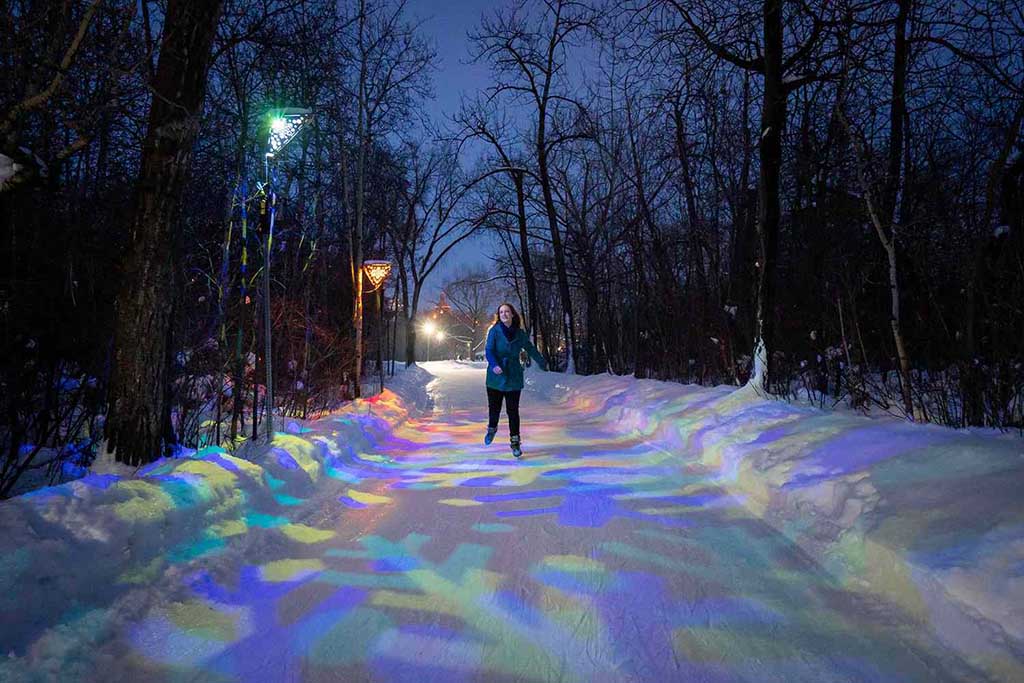
That night, back in Sherbrooke proper, I laced up a pair of skates and stepped onto an outdoor rink near Lac des Nations. Lights twinkled overhead, suspended between lampposts like stars caught in a net. The ice was smooth, the music soft, and every glide forward felt like a small triumph.
Couples held hands, children raced in zigzags, and a father taught his daughter how to fall without fear. I found a rhythm, lost it, found it again, and let the night carry me forward. Snow fell lightly, almost theatrically, and laughter echoed from one end of the rink to the other.
A café nearby served mulled wine in paper cups. I sipped it slowly, watching my breath rise and dissipate. It was quiet, not in absence of sound but in presence of peace.
8. The Quiet Beauty of Lac des Nations
In daylight, Lac des Nations transformed. I returned the next morning, walking its perimeter with a sense of reverence. The lake had frozen over, its surface veined with cracks that caught the light in slivers. Joggers passed, their breath quick and visible. A group of students practiced cross-country skiing near the shore, laughing every time someone fell.
Benches overlooked the water, and I sat for a while, letting the stillness wash over me. Ducks huddled near an unfrozen patch, occasionally flapping their wings as if to say: we are here, winter or not.
The beauty here wasn’t staged. It didn’t beg to be photographed. It simply existed—quiet, enduring, sure of itself.
9. Tasting Winter at the Marché de la Gare
Food in Sherbrooke tells its own story, especially in winter. I spent the afternoon at the Marché de la Gare, a year-round farmers’ market tucked beside the railway tracks. Inside, the smell of fresh bread mixed with aged cheese and smoked meat.
Vendors offered samples without pretense. One stall specialized in tourtière, the traditional Quebec meat pie, its crust golden and flaky, its filling rich with spice and history. Another featured cranberry preserves so tart and sweet they could wake the dead.
I bought a wedge of local blue cheese, a bottle of ice cider, and a packet of maple butter. Each item carried more than flavor—it carried place, and time, and care.
Outside, children slid down snowbanks, giggling. A man played fiddle near the entrance, his fingers flying. The cold didn’t keep people away—it drew them together.
10. A Final Stroll, A Final Glance
Late that evening, I returned to Mont-Bellevue—not for snowshoeing, but simply to walk. The trails, lightly illuminated, wound like whispers through the trees. It felt different at night—more secretive, more intimate.
Snow had started again, fine and dry. It fell in spirals, not straight lines, and settled into every crease and hollow. I walked slowly, boots crunching, hands in pockets, heart strangely full.
A fox darted across the path ahead—just a flash of red and motion—and vanished. The silence returned, even deeper now, as if the forest had exhaled.
No one else was around. The wind in the branches made a soft sound like paper turning. I stopped and listened. And that was enough.