1. Arrival in the Eastern Townships
The road into Sherbrooke was lined with trees just beginning to wake from winter. Their branches were still mostly bare, but hints of pale green whispered along the edges — buds the size of raindrops, stretching toward light after a long sleep. Patches of snow clung to the north sides of buildings, stubborn and aging, while the south-facing hills wore damp earth like a badge of seasonal progress. The air had that unmistakable scent of thaw: wet bark, cold soil, and distant blooms not yet visible but deeply promised.
I arrived in the early afternoon, windshield still misted from the morning’s drizzle. The drive from Montreal had been smooth, a steady unfolding of fields and villages, each one quietly shrugging off winter’s weight. As I entered Sherbrooke, I could feel the town breathing again — the sidewalks wet but passable, the rivers high and fast, as if eager to make up for months of being trapped under ice.
The city straddles the meeting point of the Magog and Saint-François Rivers, its streets winding gently through hills and old industrial buildings that seemed almost romantic under the early spring sky. I had heard murmurs about Sherbrooke’s art scene — of studios blooming in old factories, of murals that came alive in unexpected corners. With boots still muddy and a thermos of lukewarm coffee in hand, I set out to see what the thaw had revealed.
2. A First Stroll Through Downtown
King Street West is where the layers of Sherbrooke begin to peel back. The architecture here tells its own story — late Victorian facades beside 20th-century brickwork, shop windows with mismatched lettering, and galleries quietly announcing their presence with sandwich boards hand-painted in chalk.
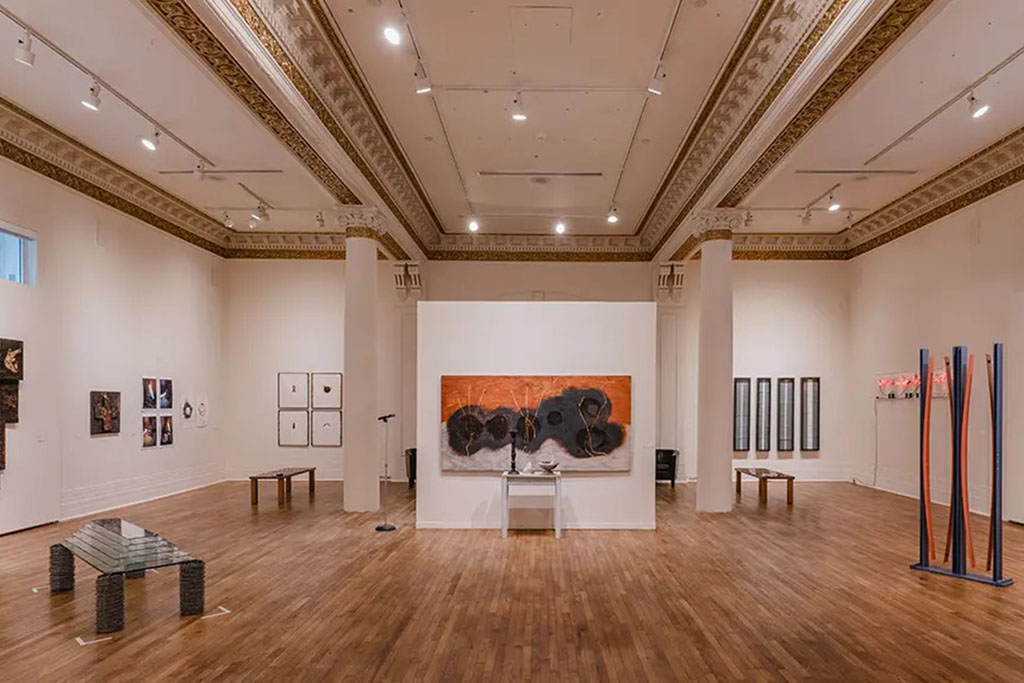
One such board read, simply: Open / Galerie d’Art Antoine Sirois. The door creaked slightly as I entered, a small bell overhead giving a single, deliberate chime. The warmth inside was immediate, not just from the heating vents still doing their part against the chill, but from the light — expertly angled track lights bathing canvases in soft gold.
The gallery smelled faintly of varnish and old wood floors. The owner, a man with a tweed vest and eyes like polished slate, nodded in greeting but didn’t intrude. I wandered alone, grateful for the silence. The works on display leaned toward the interpretive — landscapes twisted into dreamscapes, faces rendered with more emotion than anatomy. One painting in particular caught my breath: Le Printemps Retrouvé — The Return of Spring. It showed the Saint-François River breaking through its icy shell, with branches blooming beneath a snow-laden sky. A perfect contradiction. Much like the season itself.
3. Following the Murals as They Awaken
Public art in Sherbrooke doesn’t wait for a grand unveiling. It lives on walls year-round, subject to snow, sleet, and sun. The famed Murales de Sherbrooke trail is a winding path through the downtown core, where enormous, hyperrealistic murals adorn the buildings like open-air history books.
Walking the trail in early spring has a particular charm. Melting snow trickled down sidewalks, and birds chirped with the urgency of those late to nest. I stopped first at La Mémoire de Sherbrooke, a mural that stretches across the side of a building near the old post office. It depicts a snapshot of the town’s past — men in suspenders, children carrying firewood, smoke curling from chimneys. The paint, slightly dulled by winter, was still vibrant enough to draw a small crowd. I stood among them, hands in my coat pockets, letting my eyes move from brushstroke to brushstroke. The realism is uncanny; it almost feels as though the figures might move if you turn your back.
Each mural told a different story. One celebrated local musicians with instruments held mid-note. Another paid tribute to the industrial roots of the town, its smoke stacks and rail lines rendered in dramatic chiaroscuro. I passed a couple of students sketching on the sidewalk, bundled in scarves, their breath still visible in the air as they worked.
4. The Saturday Artisan Market by the River
The Marché de la Gare sits at the edge of the Saint-François River, beside the old train station where rust-colored bricks still hold the chill from January. In spring, the river swells with meltwater, and the market stirs from hibernation. I arrived just as vendors were setting up. Canvas tents flapped lightly in the breeze, weighed down with baskets of woven goods, ceramics, and paper goods that fluttered like leaves not quite ready to fall.
At one table, I watched a calligrapher slowly ink a passage from Rilke onto handmade paper. The script flowed like water, each letter blooming with the kind of care that modern fonts can’t quite mimic. She smiled without stopping her work when I complimented the piece. “Spring makes it easier,” she said. “Even ink wants to flow again.”
Next to her, a potter was arranging small porcelain bowls glazed in soft greens and blues. The colors matched the river in thaw — pale, reflective, not quite settled. He let me turn one over in my hand, explaining that the flecks in the glaze came from ground granite collected near Mont-Orford.
Under a small awning near the edge of the stalls, a trio of high school students played folk tunes on violin, guitar, and cello. Their playing was tentative but earnest, the kind of music that makes you stop even if you’re not sure why. I stayed for three songs.
5. Stepping into Lennoxville’s Quiet Corners
Lennoxville feels like a different town entirely, though it sits only minutes from downtown. The English-speaking borough is home to Bishop’s University and its quiet, ivy-wrapped campus. Here, spring felt more hesitant — the lawns were still patchy with snow, and the lilac bushes showed only the faintest hint of buds.
I stopped at the Foreman Art Gallery, which stood quietly among a grove of thawing trees. Inside, the exhibit focused on environmental memory — a fitting theme for a season so preoccupied with change. One installation used salvaged river debris to construct a flowing sculpture that arched from floor to ceiling. Bits of glass, polished driftwood, and tangled fishing line glistened under gentle lighting.
A student docent offered a soft-spoken tour. She spoke not from a script, but with the ease of someone who had lived among the art for weeks. We spoke of the way seasonal cycles influenced the pieces — how the returning light seemed to awaken the sculptures as surely as it did the city’s flora.
Before I left, I took a detour around the university’s path by the river. Small crocuses were pushing through the soil beside old stone benches. The air was cold but no longer unfriendly.
6. Workshops in Old Industrial Bones
A local baker — a man whose sourdough had a waitlist — pointed me toward a cluster of artist studios just off Rue Meadow. I found them in a former textile mill, its brick façade stained with age, the windows patched with translucent plastic where glass had failed long ago.
Inside, the building breathed a different kind of warmth — the kind made by kilns, halogen bulbs, and the quiet energy of concentration. I knocked at a door with a handwritten sign that read simply Camille. The door opened, and I was welcomed into a room that looked like someone had thrown a box of paint at a cathedral.
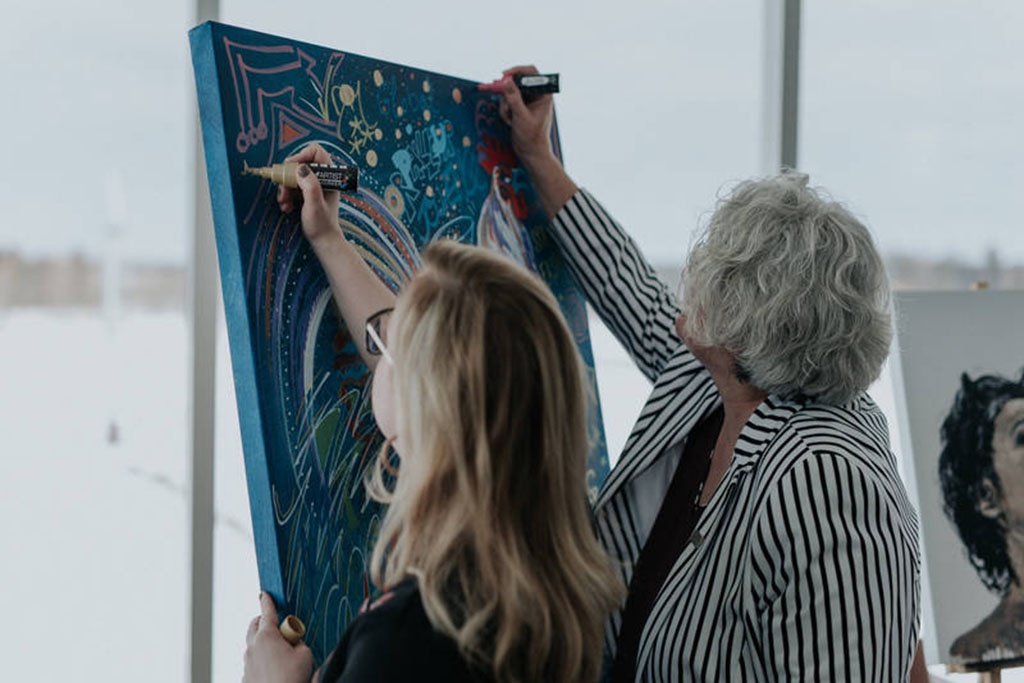
Camille was in the midst of a large abstract work, the kind that swallows a wall and half a lifetime. She gestured me in, apron stained, curls tied back with a brush still wedged above one ear. Her studio was chaos in the best way — canvases stacked, sketchbooks opened mid-thought, rags steeped in turpentine. She worked while we spoke, adding layers of yellow to a stormy blue corner of her canvas. “Spring’s a trickster,” she said. “It never arrives quietly.”
Next door, Bruno the ceramicist let me watch him pull a vase from the wheel with the delicacy of a magician. He wore a thick flannel shirt, sleeves rolled, and worked the clay like it owed him an apology. I asked if early spring made it harder. He shrugged. “Easier to focus. No parties. No excuses.”
He let me try. What I produced looked like a wounded mug. We laughed, and he wrapped it for me anyway. “Call it a self-portrait,” he said.
7. A Morning by the Lake in Melt
Lake Magog in spring is neither winter nor summer. Ice clings to the shore in thin plates, breaking like porcelain under your feet. I arrived before sunrise, mist curling above the water in long, ghostly lines. Birds called out from the reeds, still unsure if it was time to stay.
I sat on a stone worn smooth by a hundred such mornings, sipping tea from a thermos now more lukewarm than hot. The sky shifted slowly from cobalt to lavender to something that might’ve been gold if you squinted. A heron, skeletal against the light, moved slowly across the shallows.
There was no one else. The world, for a moment, felt undecorated. A kind of art in its own right.
8. An Evening at La Capsule Bistro-Cinéma
That night, I returned to town for a film screening at La Capsule, a place where red wine and black-and-white cinema live in the same breath. The inside was warm, with fogged windows and shelves of philosophy books that nobody pretends to have finished.
The film was a short documentary about a painter who lived alone in the Mauricie region, painting the same mountain in all four seasons for over a decade. His spring versions were the least defined, more suggestion than statement. “Too much uncertainty,” he explained onscreen. “I can’t paint what hasn’t decided what it is.”
I stayed after for a plate of chèvre croquettes and a small glass of something red and persuasive. Around me, strangers debated quietly about technique, funding, and whether digital media counted as sculpture. Nobody raised their voice. Everyone listened.
9. The Final Morning’s Quiet Drift
The following morning, I walked slowly along the path by Parc Jacques-Cartier. Pigeons strutted through puddles, and toddlers, freed from layers of wool and caution, toddled after them. Musicians played accordion under a tree still waiting for its leaves. The river rushed by, unbothered by time.
The murals watched quietly from their walls. The shops opened their doors a little earlier. The city felt like it was inhaling again.